
Designing for Independence Prospect Heights, Illinois
Case Study
Prospect Heights Whole-House Renovation & Addition
Location: Prospect Heights, IL · Type: Whole-House Renovation & Addition · Status: Completed · Scope: Sunroom, home office, art room, bedroom, kitchen, dining room, accessibility upgrades throughout
"I just had lunch and put my dishes in the sink and washed them. I got a little teary-eyed because I was proud of myself and it's been almost 30 years since I've washed my dishes."
What begins as a sunroom can become something much larger — if you're willing to listen.
The project started simply enough: a sunroom and greenhouse addition, with some accessibility modifications to the bedroom for a client who uses a motorized wheelchair. She wanted a room that felt like the outdoors, where she could grow plants and paint. The bedroom needed to work better for her. That was the scope.
Midway through the design process, she made a decision that transformed the project entirely. If construction was already underway, this was the moment — perhaps the only moment — to address every daily frustration that had accumulated over years of living in a home that wasn't designed for her. The kitchen, the dining room, door locations, counters, windows — every surface she touched every day became part of the conversation. Her family stepped in to help make it possible.
What followed was a demanding and exceptionally meaningful design processes.

The Design Challenge
Accessibility in architecture is frequently misunderstood. Applying ADA guidelines — a term that is itself a misnomer in the residential context — is a starting point, not a solution. Real accessibility design begins where the guidelines end: with the specific person, the specific disability, the specific needs that no code document has ever anticipated.
This project demanded a process of questioning everything. What height should countertops be — not in general, but for this client's specific motorized wheelchair? Where should outlets, light switches, window sills, and shelves land to be genuinely reachable? How do you design a floor transition between materials of different thicknesses so that the final surface is completely flush — no edge, no bump, no obstacle for a wheelchair?
We evaluated window manufacturers extensively before landing on the Pella Impervia Easy Slide casement — and we brought the client to the Pella showroom to test it herself. The conclusion was unambiguous: it was the only window she could operate independently. The Easy Slide's opener mechanism requires no gripping, no turning, no forcible pushing or pulling. In our experience across multiple projects, it remains the only truly accessible window on the market. We also tested door levers and locking mechanisms with the client directly, selecting hardware matched to her specific gripping capability.
Every decision went through that same filter: not "does this meet code" but "does this work for her."

The Spaces
The Sunroom The addition is anchored by a large indoor pergola — a bold design decision that some might question on first instinct. A heavy, substantial element in an otherwise light and airy room could easily work against it, pulling the ceiling down, closing the space in. We made the choice deliberately. The pergola doesn't diminish the room's loftiness so much as it transforms its character — turning what might have been simply a large sun-filled room into something that genuinely feels like the outdoors brought inside. Alongside the full-height windows and skylights, it gives the space a sense of place that no amount of square footage alone could achieve. She can hang plants from it, string patio lighting through it, and sit beneath it in a room that doesn't feel like a room.
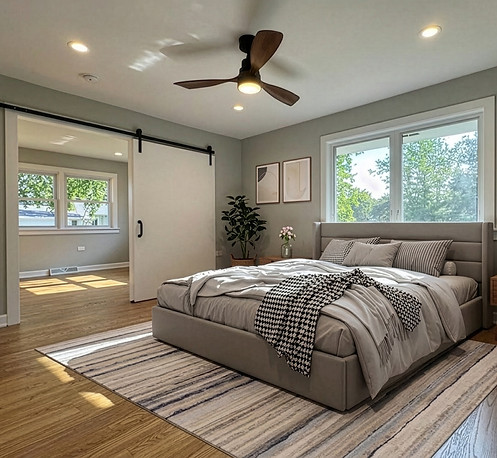
The Art Room Sun-filled, with an oversized closet behind a barn door — the preferred hardware for wheelchair users, who benefit from the wide, lateral swing rather than a swinging door in a tight space. The closet stores her easel and supplies. She has told us she is painting again for the first time in years.


The Home Office A custom wood counter runs the full width of the room, designed to sit perfectly flush with the sill of two large windows. When she works, the desk and the outdoors are at the same level. She looks out, not up. It is a small decision with an outsized effect on how connected she feels to the world outside.
The Kitchen Completely reimagined. Appliances positioned at heights calibrated to her chair. Countertops built to the exact dimensions of her specific wheelchair. An induction cooktop — chosen for safety, so she could finally cook on her own. Every element designed so that the kitchen would be hers to use, not to navigate around.


Kitchen before and after
When the project was complete, the client sent a message.
"I just had lunch and put my dishes in the sink and washed them. I got a little teary-eyed because I was proud of myself and it's been almost 30 years since I've washed my dishes."
Architecture is often evaluated on beauty, or efficiency, or innovation. Those things matter. But they are not the whole story. The small decisions — the counter height, the window hardware, the door lever tested in person until the geometry felt right — accumulate into something larger than any single choice. They accumulate into a life that works.
This project is a reminder of why the work matters.
Before and After


Working on a similar project?Contact Albert directly at albertw@babaarchitects.com or 617-840-2064.
Gallery


Furniture and décor in photographs have been added digitally for presentation purposes. Architectural work completed 2024.